Balancing extreme tensile strength and practical machinability presents a major engineering challenge today. Designing high-stress components requires materials capable of surviving heavy loads. Engineers must achieve this without breaking budgets or destroying cutting tools rapidly.
We often turn to 4140 steel to solve this problem. It acts as a highly versatile chromium-molybdenum (chromoly) alloy. Industries across the globe prize it for exceptional fatigue strength, toughness, and impact resistance. It forms the backbone of countless heavy-duty applications.
While this alloy offers superior mechanical properties, successful 4140 steel CNC machining demands strategic planning. You must make careful decisions regarding the material state, tooling selections, and thermal management. We will explore how to optimize these variables for your next project.
Key Takeaways
4140 steel offers high tensile strength (up to 148,000 PSI) and excellent fatigue resistance, making it the industry standard for high-torsion applications.
Choosing between Annealed and Quenched & Tempered (Q&T) states drastically alters machinability, chip control, and tooling requirements.
Unlike gummy materials (like 304 stainless steel), 4140 provides predictable cutting behavior when proper carbide tooling and feeds are applied.
Welding 4140 requires strict pre-heating and post-weld cooling protocols to prevent cracking and hydrogen embrittlement.
1. Why 4140 Steel is a Top Choice for High-Stress Components
Engineers consistently face a difficult material selection problem. They often need an alloy bridging the gap between affordable mild steels and costly exotic superalloys. Mild steels lack the durability required for cyclic loading. Exotic metals destroy project budgets quickly. 4140 steel steps into this exact void perfectly.
The core material properties stem from a carefully balanced chemical composition. It starts as an iron base. Manufacturers add precise amounts of Chromium, Molybdenum, Carbon (0.38%–0.43%), and Manganese. Chromium enhances overall hardness and minor corrosion resistance. Molybdenum deeply improves hardenability and structural uniformity. The specific carbon content delivers massive strength without making the metal hopelessly brittle.
These elements create impressive performance metrics. Depending on the specific heat treatment, the ultimate tensile strength ranges from roughly 95 to 148 KSI. It also maintains high impact resistance under sudden shock loads.
Beyond raw numbers, we must look at predictable shop-floor performance. Machinists hold a unique insight regarding this chromoly alloy. Despite its formidable hardness, shop floors favor it over softer yet problematic materials like 304 stainless steel. 304 stainless acts "gummy" during heavy cuts. It causes severe work-hardening issues and sudden tool failures. Conversely, 4140 cuts predictably. It forms manageable chips and behaves consistently across long production runs.
Best Practices for Material Selection
Always verify the exact chemical certification of your raw stock. Minor deviations in carbon content alter your required cutting speeds significantly.
2. Annealed vs. Pre-Hardened (Q&T): Evaluating the Right Material State
The raw state of your steel dictates the entire manufacturing workflow. This decision ultimately controls final part pricing and production timelines. You essentially choose between two distinct processing paths.
The Annealed state works best for heavy material removal. It features a machinability rating of roughly 55% compared to baseline 1018 carbon steel. We recommend this softer state for specific workflows. Components requiring deep milling, heavy turning, or complex geometries benefit greatly here. You rough out the shape efficiently before sending the part for final hardening.
The Quenched & Tempered (Q&T) state serves best for precision work. Suppliers typically provide Q&T stock hovering between 28 and 32 HRC. This state presents a counterintuitive advantage. It possesses a lower machinability rating (45-50%). However, Q&T 4140 often yields superior surface finishes. The increased hardness allows the cutting tool to sheer the metal cleanly. This creates better chip breakage than the softer, sometimes tear-prone annealed state.
You must understand the post-heat treat realities. Hardening the material changes the required manufacturing processes completely.
Below 35 HRC: Standard carbide turning and milling operate efficiently.
35 to 40 HRC: Speeds must drop. Tool wear accelerates noticeably.
Above 40 HRC: Machining shifts drastically. You must abandon standard milling. You rely entirely on grinding or Electrical Discharge Machining (EDM). Cycle times and operational costs skyrocket.
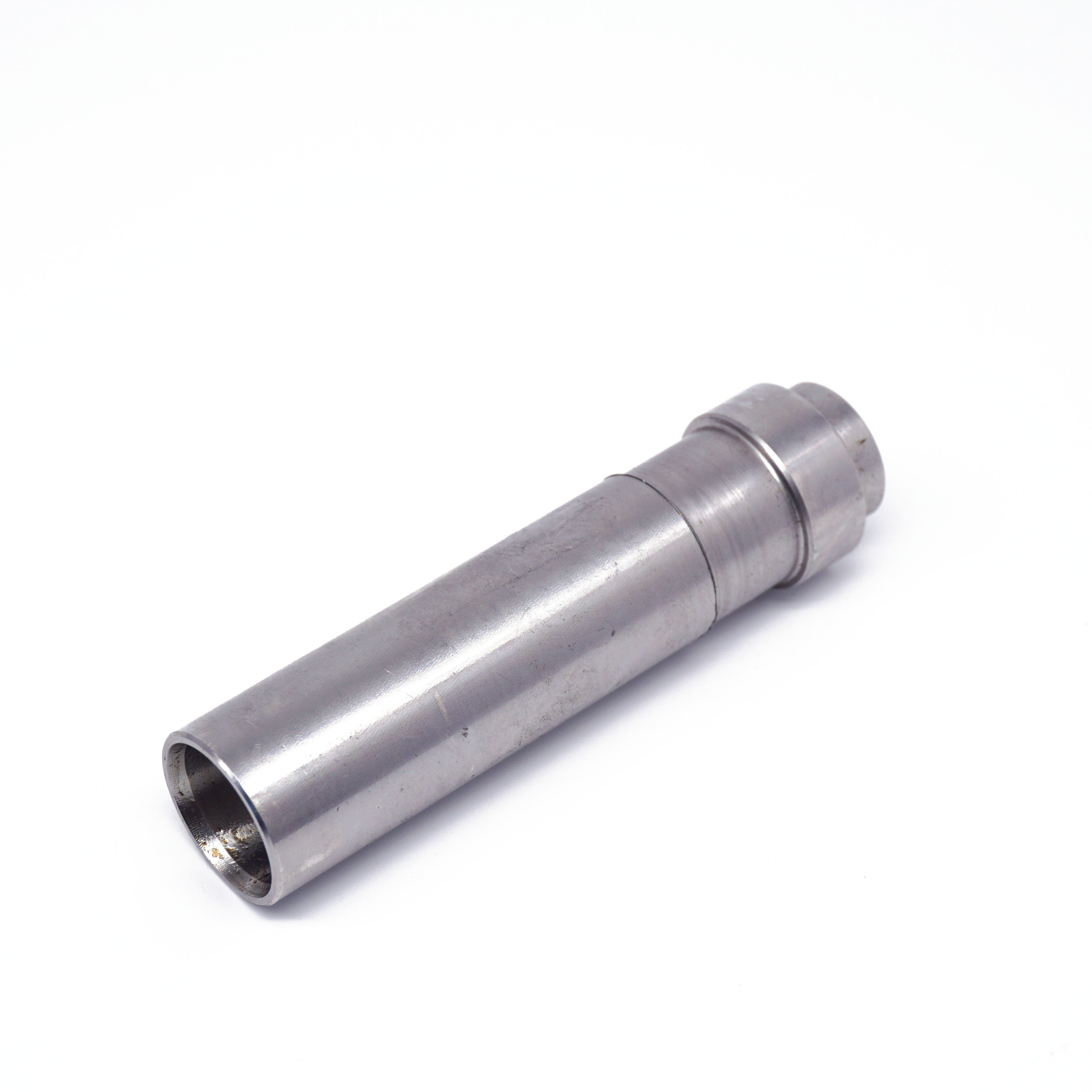
3. CNC Machining Parameters and Design Tips for 4140
Achieving tight tolerances demands strict adherence to proven machining parameters. Chromoly steel acts abrasively against standard tooling. Implementing a rugged tooling strategy prevents catastrophic failures.
We highly recommend multi-layer TiAlN or TiCN coated carbide inserts. These specific coatings withstand the intense friction generated by chromoly steel. Uncoated tools simply degrade too fast. They lose their cutting edge and ruin surface finishes.
Implementing correct speeds and feeds determines your success. You must push the material hard enough to shear it, but not enough to burn the tool. Consider these implementation data points:
Roughing operations: Target 70–100 Surface Feet per Minute (SFM) or 21–30 m/min.
Finishing operations: Target 100–140 SFM for cleaner surface finishes.
Feed rates: Maintain a steady 0.15–0.3 mm/rev depending on the tool diameter.
Many novice programmers make a critical error here. They attempt to "baby" the cut by feeding the tool too slowly. Feeding too slowly generates excessive rubbing instead of cutting. This friction causes built-up edge (BUE). Material welds itself to the tool insert, leading to immediate and premature tool wear.
Thermal management plays a massive role in successful 4140 steel CNC machining. You must specify the use of high-pressure flood coolant. A robust coolant blast flushes chips out of deep cavities rapidly. More importantly, it stabilizes material temperatures. Allowing heat to build up causes localized hardening, ruining subsequent cutting passes.
4. Key Applications: Where 4140 Steel Excels
Engineers match 4140's fatigue resistance and torsional stiffness to highly specific industrial applications. Understanding these use cases helps justify the material selection.
Power transmission components represent a massive sector for this alloy. Continuous cyclic loading would quickly shear weaker mild steels. Manufacturers rely on 4140 to build the standard Machine Shaft. These rotating components endure constant torque and bending moments across thousands of operating hours.
HVAC and fluid dynamic systems also demand robust materials. Large commercial air handlers and industrial pumps operate under high-RPM stress. You need high dimensional stability to prevent severe vibration. Engineers frequently specify 4140 for a heavy-duty Blower Shaft. The alloy prevents deflection and ensures smooth power delivery over the equipment's lifespan.
Heavy industry uses stretch even further. You will find this material inside automotive axles, CNC gear hubs, and heavy equipment linkages. Any component facing brutal impact loads relies on the toughness provided by chromoly alloys.
5. Processing Risks: Welding and Thermal Distortion
We must address the specific downsides of 4140 rather than presenting it as a flawless material. Risk management ensures safer engineering outcomes. While it machines beautifully, thermal processing introduces severe hazards.
Welding presents massive challenges. The high carbon content makes it extremely susceptible to thermal shock. When you apply intense welding heat and allow rapid cooling, the microstructure fractures. This high risk of thermal cracking destroys component integrity. Additionally, hydrogen embrittlement occurs frequently if moisture enters the weld pool.
You must follow strict mitigation protocols to weld safely. First, state the absolute necessity of matching filler metals to the alloy's high tensile strength. Using a weak filler creates an immediate failure point.
Second, require comprehensive pre-heating. You must heat the entire component slowly before striking an arc. Optimally, aim for temperatures roughly 15°C below the part's previous tempering temperature. Finally, you must control post-weld cooling. Wrap the part in thermal blankets. Follow up immediately with controlled post-weld hydrogen bake-outs to release trapped gases.
Common Mistakes in Welding
Never air-cool a welded 4140 assembly on a cold shop table. The rapid temperature drop guarantees micro-cracking along the heat-affected zone.
6. Shortlisting 4140: Alternative Material Comparisons
Buyers need a clear evaluation lens. You must decide if 4140 represents an over-engineered or under-engineered solution for your specific project. Comparing it against common alternatives clarifies the decision.
Look at 4140 versus 4130 steel. 4130 contains lower carbon (0.28%–0.33%). This lower carbon content makes 4130 significantly easier to weld and form. Airplane fuselages often use 4130 tubing for this reason. However, 4140 wins handily on raw tensile strength and high-stress durability.
Compare it against 1018 carbon steel. 1018 acts as the industry baseline. It is vastly cheaper and much easier to cut, boasting a 100% machinability rating. Yet, 1018 lacks true structural integrity. It cannot survive as a load-bearing gear or high-torque shaft.
Material Grade | Carbon Content | Machinability Rating | Best Application Use |
1018 Steel | 0.15% - 0.20% | 100% (Baseline) | Low-stress pins, mounting plates, general fixtures. |
4130 Steel | 0.28% - 0.33% | 70% | Welded tubular structures, moderate stress parts. |
4140 Steel (Annealed) | 0.38% - 0.43% | 55% | High-stress gears, deep milled heavy components. |
4140 Steel (Q&T) | 0.38% - 0.43% | 45% - 50% | Precision shafts, heavy equipment linkages. |
Your next-step action involves finalizing exact specifications. Advise your engineering teams to nail down required HRC ratings before requesting quotes. Sending incomplete drawings results in highly inaccurate pricing from manufacturing partners.
Conclusion
Proper 4140 steel CNC machining offers an unparalleled balance of high-end mechanical properties and manageable machinability. You secure immense tensile strength without sacrificing your ability to hold tight tolerances. Engineers continuously rely on it to replace failing mild steel components.
To maximize your manufacturing efficiency, take these actionable steps. First, prioritize the Q&T state for tight-tolerance parts to guarantee superior surface finishes. Second, dial in precise speeds and feeds using coated carbide inserts to prevent rapid tool failure. Finally, always partner with a machine shop highly experienced in hard-metal tooling strategies and thermal management.
FAQ
Q: Can 4140 steel be machined after hardening?
A: Yes, but standard cutting tools fail rapidly above 40 HRC. Hard-turning, grinding, or EDM is required for 4140 that has been quenched to its peak hardness (54–59 HRC) or nitrided (60+ HRC).
Q: Is 4140 harder to machine than 304 stainless steel?
A: While physically harder in terms of yield strength, machinists generally find 4140 easier to cut because it chips predictably and doesn't suffer from the extreme work-hardening ("gumminess") of 300-series stainless steels.
Q: Does 4140 steel need coolant during CNC machining?
A: Yes, high-pressure flood coolant is highly recommended to evacuate chips rapidly, prevent tool burning, and maintain the material's structural temper.


