Engineers constantly walk a tightrope when designing metal components. You must balance a material's mechanical properties, like yield strength and hardness, against its practical manufacturability. Tool wear and cycle times dictate whether a project succeeds or fails financially. Selecting the wrong steel grade often leads to exponential increases in tooling costs. It can cause missed tolerances due to unpredictable thermal expansion during aggressive cutting. Worse, poor material choice risks premature part failure in the field.
Our goal is to provide a transparent, engineering-focused framework. We want to help you evaluate, compare, and select the right steel alloys for CNC machining. This guide prioritizes manufacturing economics and application viability over raw material prices alone. You will learn how to navigate machinability ratings, strategically plan heat treatments, and apply proven design guidelines. By understanding these variables, you can confidently specify grades capable of delivering high-performance components while keeping shop-floor realities perfectly in check.
Key Takeaways
Machinability vs. Performance: High-strength and corrosion-resistant alloys (like 316 or 4340) inherently demand slower feed rates and rigid setups, increasing unit costs compared to baseline carbon steels.
Heat Treatment Timing: Deciding whether to machine in an annealed state (followed by heat treatment and grinding) or a pre-hardened state dictates the final dimensional stability of the part.
Cost Multipliers: Material raw cost is secondary; machinability ratings (where 1215/1018 serves as the 1x baseline) are the true drivers of CNC project economics.
Application-Driven Selection: Minor alloy additions (e.g., Nickel in 4340 or Copper in 17-4PH) drastically alter a part's suitability for heavy-duty components like a machine shaft or high-stress aerospace fittings.
Evaluating Major Steel Categories for CNC Machining
Steel is not a monolithic material. Manufacturers categorize steel into distinct families based on chemical composition. Each category behaves differently when subjected to the extreme cutting forces of a CNC mill or lathe. Understanding these broad groups helps you narrow down options quickly.
Carbon & Free-Machining Steels: These form the baseline for CNC processes. They offer excellent machinability and lower raw costs. However, they remain limited in tensile strength and corrosion resistance. They fit perfectly into high-volume, low-stress applications where production speed matters most.
Alloy Steels: This category offers a tailored balance. By adding elements like Chromium, Molybdenum, and Nickel, alloy steels achieve superior toughness, wear resistance, and fatigue strength. Working with these grades requires strategic heat treatment planning to maximize their potential.
Stainless Steels: These grades prioritize oxidation and chemical resistance. They present unique machining challenges, primarily work-hardening. This phenomenon requires specific tooling, rigid setups, and aggressive cooling strategies to prevent rapid insert degradation.
Tool Steels: Metallurgists engineer tool steels for extreme abrasion resistance and thermal stability. Shops typically machine them in an annealed state due to their extreme baseline hardness. Because they require robust heat treatment and final grinding, they inherently carry high processing costs.
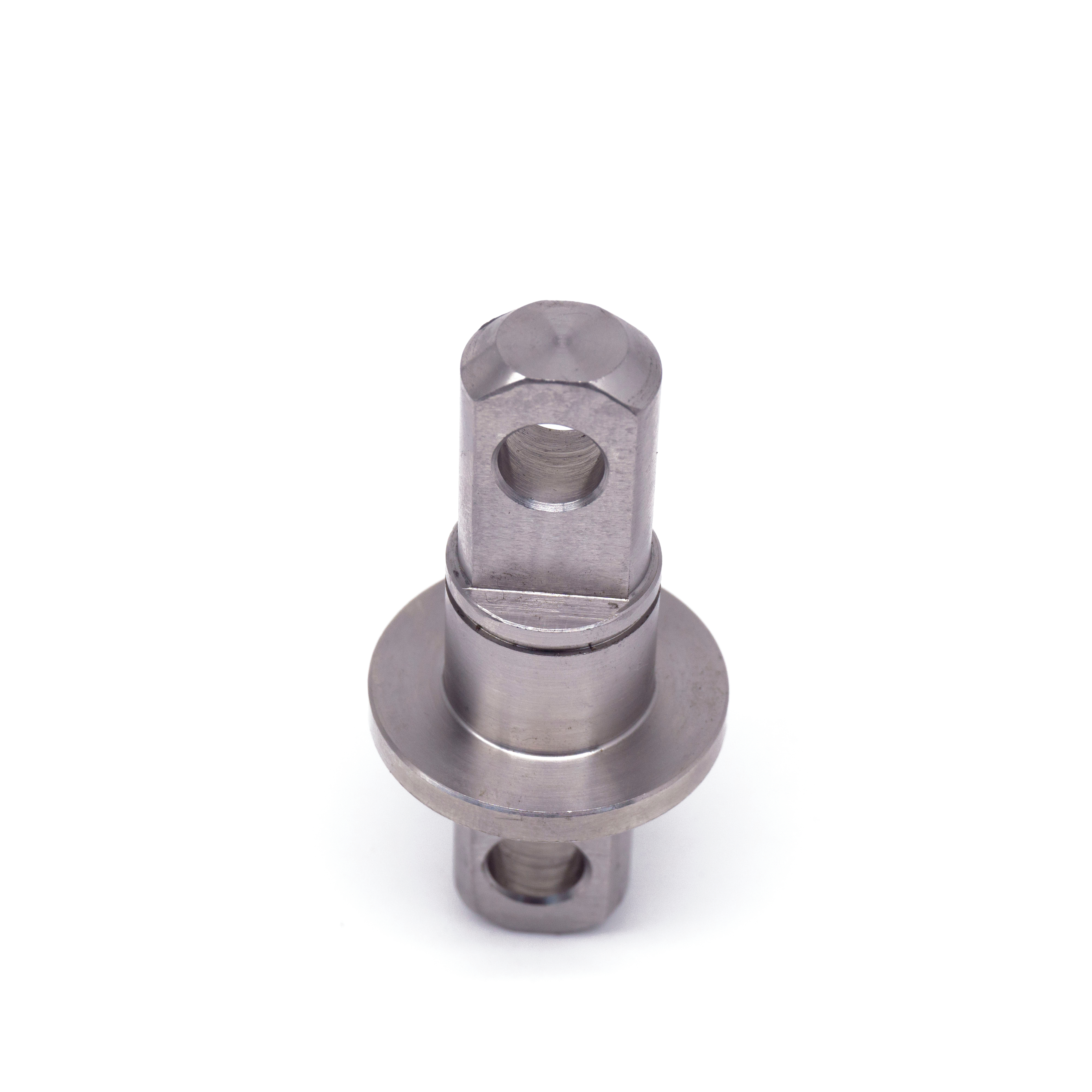
Core Steel Grades for CNC Machining: Properties and Trade-Offs
Once you select a broad category, you must specify an exact grade. Minor chemical variations radically change how a metal cuts, hardens, and survives in its final environment. Let us examine the most common grades.
Alloy Steels (4140 vs. 4340)
Alloy steels dominate structural applications. The choice often comes down to 4140 or 4340.
4140 (Chromium-Molybdenum): This acts as the industry standard for tough, general-purpose components. It responds beautifully to heat treatment. You will often see it specified for gears, fasteners, and any standard Machine Shaft.
4340 (Nickel-Chromium-Molybdenum): The defining difference here is Nickel. Adding Nickel allows for deep, consistent hardening even in thick cross-sections over 50mm. Engineers reserve 4340 for severe-impact and heavy-load applications, such as aircraft landing gear.
Stainless Steels (303, 304, 316, 17-4 PH)
Stainless grades trade machinability for environmental resistance. Your choice directly impacts cycle times.
303 vs. 304: Grade 303 adds sulfur to break up chips, offering excellent machinability. However, it sacrifices some corrosion resistance and weldability compared to the 304 baseline. Grade 304 remains the all-purpose austenitic standard.
316: This grade contains molybdenum, granting it marine-grade corrosion resistance. It proves highly susceptible to work-hardening during CNC cutting. Operators must use rigid tooling and prevent the tool from "dwelling" or rubbing on the part surface.
17-4 PH: This is a precipitation-hardening stainless steel containing copper. You can machine it in a relatively soft solution-annealed state. Afterward, it easily hardens via low-temperature aging. This yields high strength and minimal dimensional distortion.
Mild & Free-Machining Steels (1018, 1215)
When you do not need extreme strength, low-carbon variants keep budgets manageable.
1018: This is a tough, highly weldable mild steel. It accepts carburizing (case hardening) extremely well, allowing for a hard outer shell over a ductile core.
1215: Designed as a free-cutting grade, it produces small, manageable chips. It acts as the ideal choice for high-speed automatic lathes producing non-critical fastening hardware, like a standard Shaft Pin. Note that you cannot heat-treat 1215 for core strength.
Tool steels endure brutal environments but demand patience during manufacturing.
D2: A high carbon, high chromium alloy designed for extreme wear resistance. It sees heavy use in stamping dies and industrial cutting tools.
H13: This grade brilliantly resists thermal fatigue. It remains the absolute standard for injection molds, extrusion dies, and hot-work tooling.
Grade Comparison Summary
Material Grade | Primary Category | Relative Machinability | Best Suited For |
1215 | Free-Machining | 136% (Excellent) | High-volume pins, fasteners |
1018 | Mild Steel | 100% (Baseline) | Weldable brackets, fixtures |
4140 | Alloy Steel | 66% (Moderate) | Shafts, gears, tough components |
316 | Stainless Steel | 36% (Poor) | Marine environments, medical |
17-4 PH | Stainless Steel | 45% (Fair) | Aerospace fittings, pump shafts |
The "Machinability Multiplier": Cost and Manufacturing Implications
Material prices fluctuate, but machine time remains consistently expensive. When evaluating manufacturing economics, raw material cost is rarely the deciding factor. Instead, you must look at machinability ratings.
Understanding the Baseline
We typically frame low-carbon steels, like 1018, as the 1x cost and time baseline for a standard Machined Part. This material allows for optimal surface feet per minute (SFM) and extends the life of carbide inserts. If your design works flawlessly in 1018, upgrading simply wastes budget.
Hidden Costs of Toughness
Upgrading to a tougher alloy brings hidden manufacturing penalties. Moving from 1018 to 4140 typically increases machining time by roughly 1.5x to 2x. The spindle must slow down, and feed rates drop to prevent tool breakage. Specifying 316 stainless or heavy Tool Steels can push machining costs to 3x or 5x the baseline. These robust materials drastically reduce SFM and increase tool degradation. You end up paying for both the extra machine hours and the frequently replaced cutting inserts.
Work-Hardening Risks
Austenitic stainless steels (the 300 series) present a brutal mechanical reality. If a cutting tool loses its edge and stops slicing efficiently, it begins to rub against the material. This rubbing generates immense friction and instantly hardens the material's surface layer. Once work-hardening occurs, it readily destroys carbide inserts on the next pass. Operators must use extremely rigid setups, flood coolant, and continuous heavy feeds to stay underneath the work-hardened zone.
Heat Treatment and Surface Finishing Strategies
Machine shops rarely deliver high-performance steel parts in their raw state. Post-processing defines the final mechanical profile. Understanding when and how to treat your metal determines its ultimate success.
Pre-Machining vs. Post-Machining Heat Treat
Timing the heat treatment represents a crucial engineering decision.
Annealing and Normalizing: We use these processes to soften the steel before machining. A softer state allows for aggressive roughing and the creation of complex geometries without breaking tools.
Quenching and Tempering: After rough machining, parts undergo quenching to achieve target hardness, followed by tempering to restore some ductility. This process poses a high risk of warpage. To achieve tight tolerances, you must leave extra material on the part and utilize post-treatment precision grinding.
Precipitation Hardening
Certain alloys offer a massive manufacturing advantage. Alloys like 17-4 PH utilize a process called precipitation hardening. You can machine them comfortably in a solution-annealed state. Following the machining phase, an aging process (such as H900) brings them to maximum strength. This low-temperature aging yields highly predictable, minute dimensional changes. It preserves your CNC tolerances without demanding expensive post-grind operations.
Surface Finishes
You must match the alloy grade to an appropriate surface treatment.
Nitriding: Excellent for 4140. It diffuses nitrogen into the surface, creating an incredibly hard, wear-resistant case while leaving the core tough.
Passivation: Mandatory for 304 and 316 stainless steels. This chemical bath removes free iron left behind by cutting tools and restores the protective chromium oxide layer, preventing premature rust.
Design for Manufacturability (DFM) Guidelines for Steel
Designing for aluminum differs vastly from designing for hard steel alloys. The intense cutting forces required to shear steel demand specific design adaptations to ensure quality and prevent scrap.
Wall Thickness and Deflection: Steel cutting generates massive tool pressure. This pressure pushes against the part, causing thin features to deflect. Deflection leads to chatter marks and dimensional inaccuracy. Always prioritize rigid part geometry. Avoid thin walls wherever possible; maintain a minimum recommended thickness of 0.8mm to 1.5mm depending on the part's overall height.
Internal Radii: Sharp internal corners require tiny end mills. Small end mills deflect easily and snap frequently when cutting hard steel. Specify the largest possible internal corner radii. Larger radii allow machinists to use larger, stronger end mills, which drastically reduces tool breakage and shortens cycle times.
Selective Tolerance and Finish Callouts: Avoid applying blanket tolerances to your entire drawing. Over-specifying tight tolerances or high surface finishes (such as Ra 0.8) on non-mating surfaces is a common mistake. On hard alloys, achieving an Ra 0.8 surface finish exponentially drives up polishing and grinding costs. Only specify tight requirements on functional, mating surfaces.
Engineer’s Decision Matrix: Specifying the Right Steel Alloy
Selecting materials does not require guesswork. You can utilize a logical process of elimination to find the most cost-effective and functionally viable grade.
The "If... Then" Shortlisting Logic
If the part needs moderate strength and will be mass-produced with no welding requirements... Then evaluate 1215 to maximize production speed.
If you need a high-strength shaft but the cross-section is under 2 inches (50mm)... Then default to 4140. It saves significant material costs over 4340 and hardens perfectly at that thickness.
If extreme corrosion resistance is required in a chloride or marine environment... Then specify 316. Accept the machining cost premium as a necessity for survival.
If the part requires high strength, corrosion resistance, and complex post-machining dimensional stability... Then specify 17-4 PH. The savings from avoiding post-heat-treat grinding often offset the material's higher baseline cost.
Vetting a CNC Partner
Your choice of manufacturing partner matters just as much as your material selection. Look for specific criteria when selecting a supplier. Check their capability with 5-axis rigid setups, which reduce the need for multiple re-fixturings. Ensure they utilize advanced CAM simulation software for tool-path optimization. Finally, verify their experience managing thermal expansion during high-feed steel milling, as inexperienced shops will consistently miss tight tolerances on hard metals.
Conclusion
There is no universal "best" steel alloy in manufacturing. There is only the most mathematically sound choice based on your yield strength requirements, environmental exposure risks, and project budget. Navigating these choices requires balancing the raw material cost against the hidden penalties of poor machinability.
Always base your final selection on the precise demands of the application. Do not over-specify a hardened aerospace grade for a low-stress bracket. Conversely, do not cut costs on a heavy-impact shaft where an alloy upgrade would prevent catastrophic failure.
We highly recommend involving your CNC machining partner early during the DFM phase. By collaborating early, you align your material specifications with actual machine-shop realities, tool availability, and optimal processing methods. This proactive approach guarantees higher quality, faster turnaround times, and superior budget control.
FAQ
Q: What is the difference between 4140 and 4340 steel for CNC machining?
A: The primary difference lies in the chemical composition. Grade 4340 contains Nickel, whereas 4140 does not. This added Nickel gives 4340 superior hardenability, allowing it to through-harden consistently in thick cross-sections (over 50mm). While 4140 is standard for general shafts, engineers reserve 4340 for extreme-impact, heavy-load applications where deep strength is mandatory.
Q: Why is 303 stainless steel cheaper to machine than 304 or 316?
A: Grade 303 includes added sulfur. This addition fundamentally alters the material's cutting mechanics by breaking up chips cleanly as the tool passes. Unlike 316, which exhibits aggressive work-hardening and burns through carbide inserts quickly, 303 cuts smoothly at higher speeds, dramatically reducing cycle times and tooling costs.
A: Yes, you can CNC machine them, but rarely in their final hardened state. Shops typically rough-machine D2 and H13 while they are in a softer, annealed condition. After roughing, the parts undergo extensive heat treatment to achieve maximum hardness. Shops then finish the tight-tolerance features using EDM (Electrical Discharge Machining) or precision grinding.
Q: How does heat treatment affect the dimensional tolerances of a steel machined part?
A: Heat treatments involving extreme temperature changes, especially quenching, induce internal stresses that cause metal to warp or expand. This distortion ruins tightly machined tolerances. To combat this, machinists intentionally leave extra material on the part before heat treatment. After the part hardens and stabilizes, they use grinding allowances to finish the dimensions perfectly.


